Before you build AI for young people, listen to these six voices
We created six personas to help tech developers and other adults understand young people’s views on AI.
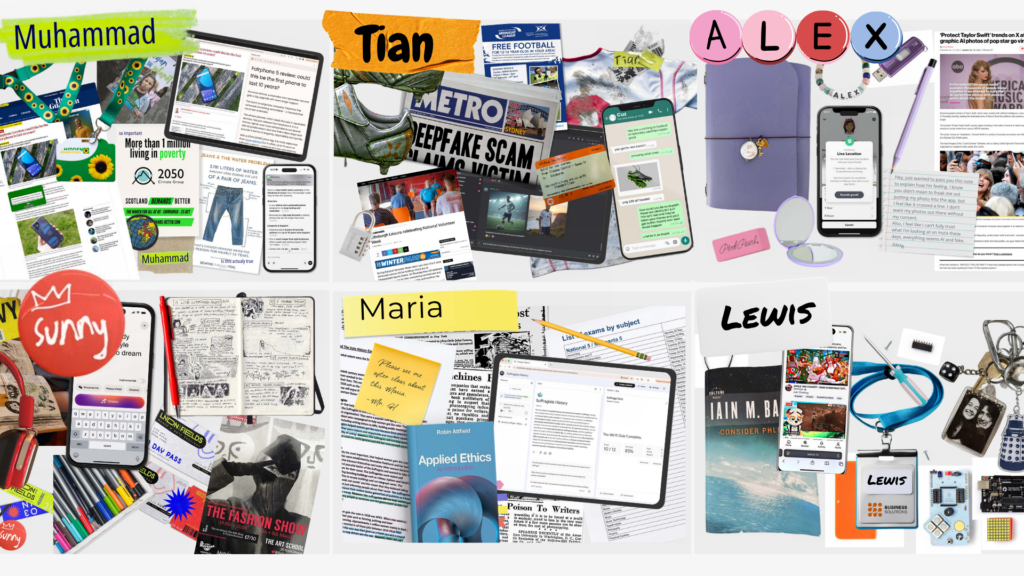
Download them now.
Our team spends a lot of time thinking about how we can help young people become skilled, critical, and responsible users of AI. But what are young people’s opinions of this emerging technology?
Over the past few years, we’ve worked with academics from the University of Edinburgh to listen carefully to what children and young people actually think about AI. Some are excited by the possibilities of new technologies. Others are worried about privacy, bias, or what AI might mean for their future careers. Many are still trying to figure it out.
Academic research is typically shared through papers, reports and toolkits. These are valuable, but we wondered if there was a more engaging way to help adults get to grips with the data, especially the people building AI technologies or introducing AI products that young people may end up using.
Meet our personas
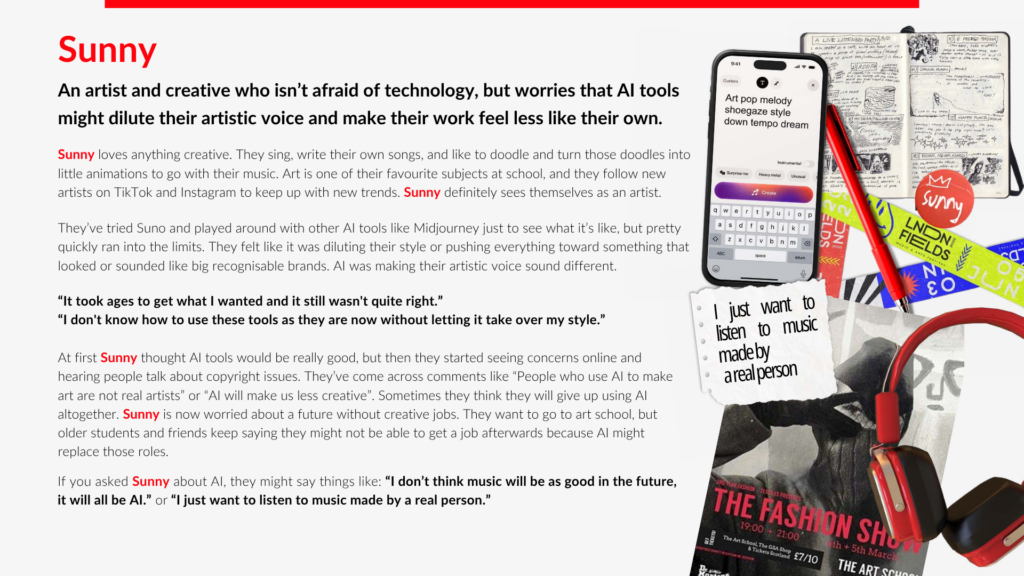
To help bring what we’ve learned about young people’s perspectives on AI to life, we’ve created six personas: Sunny, Maria, Muhammad, Alex, Tian, and Lewis.
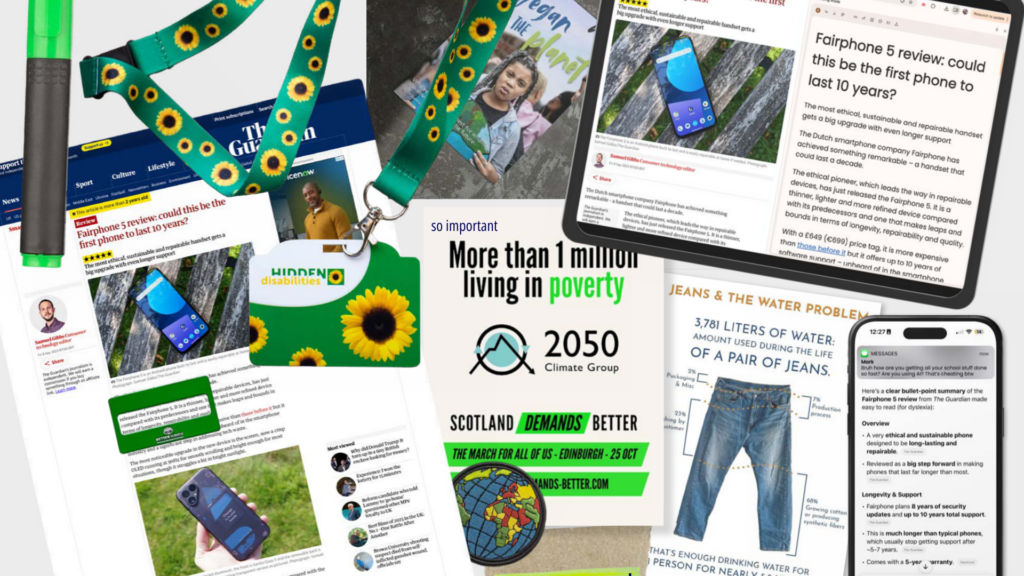
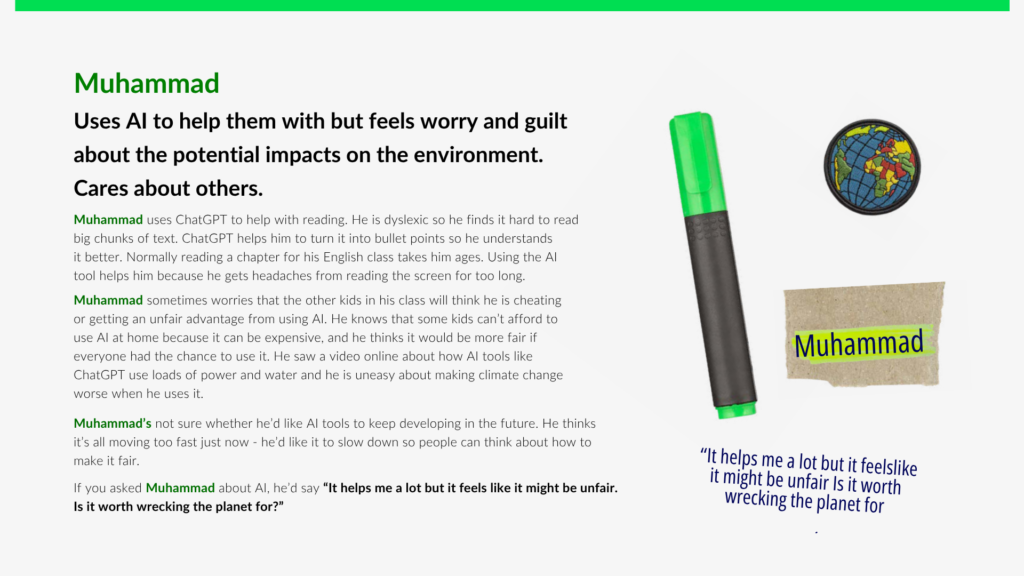
These are synthetic characters whose views, hopes, feelings and concerns have been distilled from multiple research projects involving children and young people, including audiences of our Unbelievably Creative AI Show.
They are not intended to represent individual children. Instead, they help us see the range of experiences and opinions that exist among young people today. They’re not a balanced set of personas, in fact the majority of them are negative or critical about how they see AI impacting them and others around them – but this is representative of what the research tells us young people actually think.
Why personas?
Personas are powerful because they make research feel human. They’re a useful reminder that there is no such thing as a typical young person and that we need to be cautious before assuming that all teenagers are “digital natives”, or enthusiastic adopters of AI.
Personas can be used to help decision makers, technology developers, educators and other adults to understand young people’s views and perspectives when they create or introduce AI products.
Young people’s experiences are diverse, and their views deserve to be explored with the same nuance.
Meet Sunny, the creative who doesn’t want AI to steal her style.
Maria, who was called a “cheat” by her teacher after using AI to help do her homework.
And Lewis, who loves playing with all the new AI apps.
and more…
Bringing personas to life through performance
We wanted to go further than a PDF. Could theatre make these characters feel truly real?
And would that allow impactful and meaningful conversations with the data?
We worked with Toonspeak Young People’s Theatre to bring some of these personas to life. Their young performers turned the personas into characters, and devised short scenes where they meet each other. They also wrote monologues based on those characters, expressing the opinions and attitudes from the personas.
We’ve created a downloadable package containing the personas, scene scripts and supporting materials, alongside a series of filmed monologues bringing the characters to life.
How can you use the personas?
- Use these personas to ensure decisions are aligned with real user attitudes and behaviours when scoping, building, or testing AI products with young people.
- Use them to identify and discuss risks, needs, and expectations when designing AI products for young people. Share them with developers, policymakers, or organisations designing AI products and services for young people.
- Use the monologues as discussion starters in classrooms, staff training sessions, or professional learning events.
- Run a character study with your pupils, using the personas as a starting off point to explore and share their own views.
- Put on a performance featuring our characters.
Whether you’re a teacher, school leader, researcher, youth worker, designer or anyone interested in how young people are experiencing AI, we hope you will use these resources to help spark informed conversations.
This project was developed through a collaboration between Digital Skills Education, the University of Edinburgh, and Toonspeak Young People’s Theatre, and was funded through a Google initiated gift.
You’re welcome to use these resources for education, discussion, research or design activities – please credit the project partners where appropriate.