A coding course should teach more than code
A group of teenagers from Oakland were spending part of their summer holidays learning Python. When I visited, they were working through operators and logic, using examples like calculating how much money an artist might make from music streaming (which judging by the output of my calculations, is not a lot). It was a fun and practical introduction to coding for beginners.
But the lesson wasn’t just about writing code. Alongside the technical skills, Hack the Hood deliberately creates a space for young people to talk about race, identity, bias and the impact technology can have on their community.
Their courses are aimed at young people who usually get the least access to tech education – including low income Black, Latinx, Indigenous, and Asian American and Pacific Islander youth.
A few weeks earlier, Winslow Holmes, their Technical Curriculum Director, had explained their curriculum to me as three pillars: “what I create”, “who I am” and “who I impact”.
“What I create” is probably the bit you’d expect from any technology programme or coding club. Young people learn technical skills in areas like coding, data and AI. And they’re being taught by mentors from tech companies, bringing valuable real world experience into an informal learning space.
“Who I am” asks young people to think about their own identity and how that might shape their experiences of technology and the workplace. That opens conversations about race, gender, sexuality and intersectionality.
Then there’s “Who I impact” – understanding that technology doesn’t exist in isolation. The data you use, the models you build, and the decisions you make when building a system can all affect other people.
I loved this straight away. Lots of technology education programmes concentrate almost entirely on technical skills, others might focus more on confidence or employability. It’s much less common to deliberately put all three alongside each other.
A few weeks after my chat with Winslow, I visited one of Hack the Hood’s Hustle sessions at the Renaissance Entrepreneurship Center in SoMa. The small group of teenagers I met were curious, motivated and comfortable talking to each other and to Rod, the instructor leading the session.
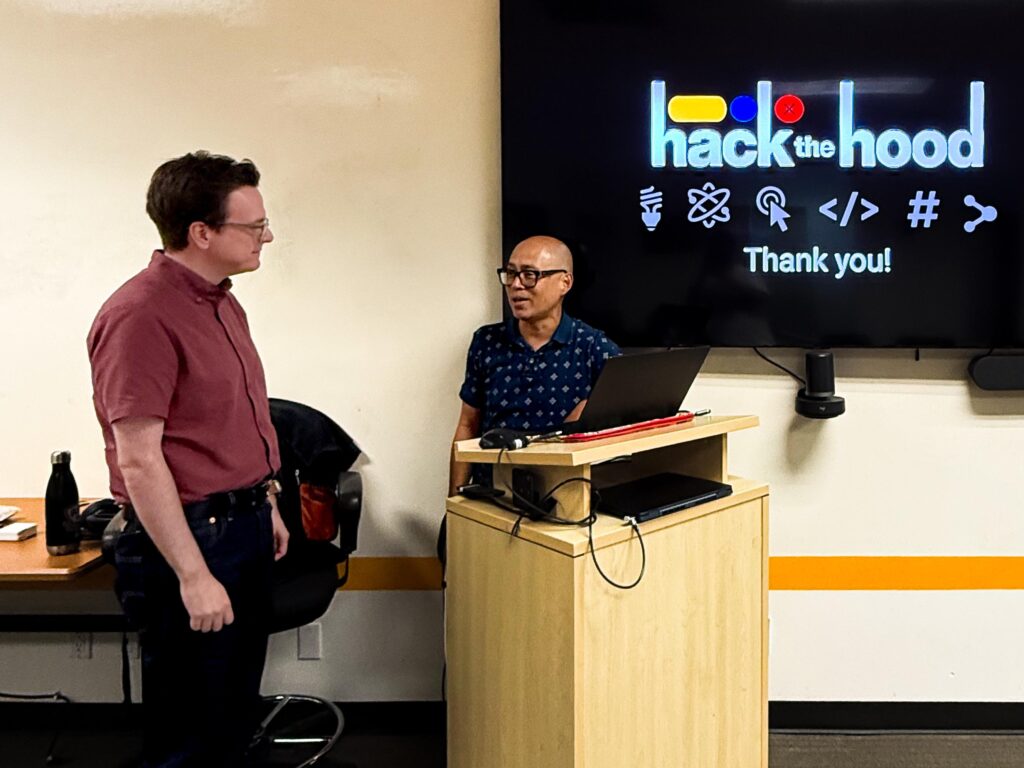
Rod is a software engineer who’s worked as a technical lead for major tech companies. Alongside those tech credentials he was an energetic and motivational leader for the group. It’s one thing to lead a team of engineers through a morning standup. It’s another to hold the attention of a room of teenagers on a sweltering Tuesday afternoon. Rod proved he could do both.
Alongside learning Python code, there was space for much wider conversations about technology and society. It wasn’t awkwardly bolted on as the serious bit everyone had to endure before getting back to coding. It felt like another part of learning about technology.
For many of the young people they work with, these aren’t entirely hypothetical discussions. Winslow had told me about learners drawing on their own experiences of technology, including well documented problems such as facial recognition systems performing less accurately on dark skin tones.
But the aim isn’t to make young people suspicious of the industry they might eventually work in. I could tell that young people on this programme were excited about the technology. Winslow told me about how many of the learners are keen to try new tools, and fanatically follow news about cutting edge tech. I like to think I keep up with AI news, but some of these teenagers made me feel like I was several models behind.
Winslow hopes learners will become responsible product owners. People who think about unintended consequences and, if they eventually find themselves sitting inside a technology company, feel empowered to ask questions about the things their team is building.
Hack the Hood is giving them practical routes towards these roles. The programme includes opportunities for certification, college pathways and chances to visit tech workplaces.
I think it’s possible to hold two ideas at the same time: to be excited about tech and its potential to create and solve problems, but also to be critical when it harms more than helps. I think a teenager learning about bias in AI can also be excited about building with it. Hack the Hood’s three pillars suggest that these can be taught simultaneously.
I only saw a small part of a much longer programme, but it left me thinking about the technology programmes I’ve been involved with in Scotland. In informal coding clubs, we don’t have to choose between teaching young people how to build technology and teaching them to think about what they’re building. Maybe both are part of learning to code.
Read more about this visit as part of my Churchill Fellowship project exploring AI in non-formal learning. Find out more about Hack the Hood.